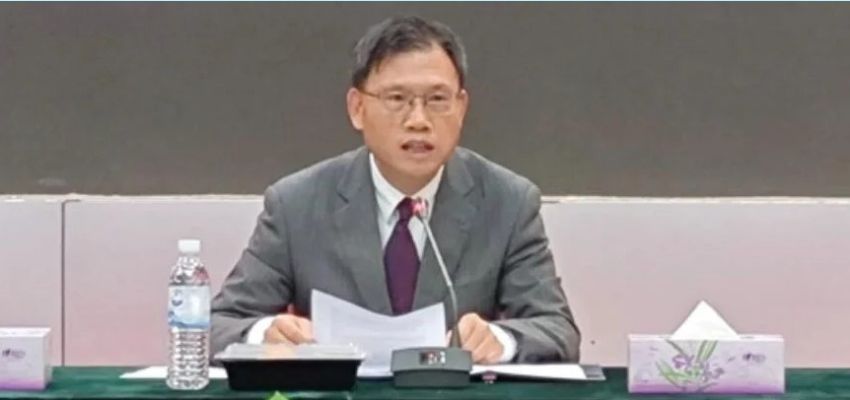
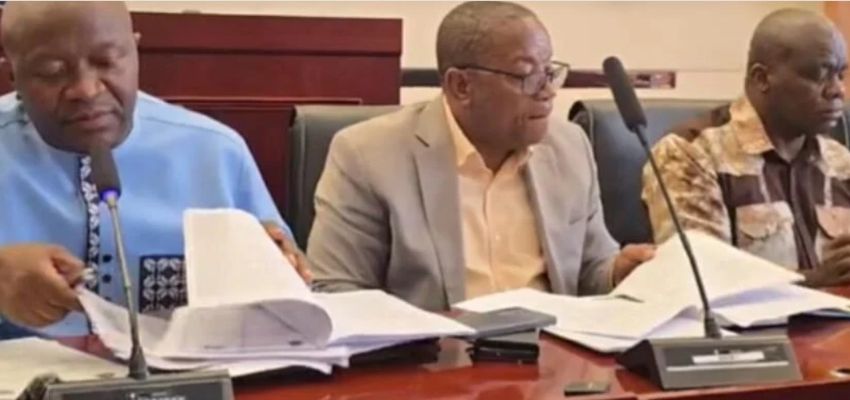
Finance and Development Planning Minister Augustine Kpehe Ngafuan, along with Deputy Minister for Fiscal Affairs Anthony G. Myers, Assistant Minister for Revenue and Tax Policy Andrew Ngollie, and the Director for Fiscal Decentralization, appeared before the Liberian Senate on Thursday to provide updates and clarification on the implementation of the country’s revenue-sharing and local government fiscal decentralization framework.
The appearance followed a formal citation from the Liberian Senate requesting clarity on the establishment of local government fiscal structures, the operationalization of the fiscal board, and progress in implementing the revenue-sharing law under Liberia’s decentralization agenda.
In a communication read before the hearing, the Senate expressed concern over what it described as the need for “clarity and information, as well as reconciling the establishment of local government and the fiscal board in accordance with the full implementation of the revenue-sharing law.” The Senate further emphasized that the ministers’ appearance would enable lawmakers to make “decisions from an informed position.”
Responding to lawmakers, Finance Minister Augustine Kpehe Ngafuan said he appeared alongside senior technical officials due to the complexity and importance of the matter, noting that fiscal decentralization remains a long-term national reform process.
He explained that Liberia’s decentralization agenda has evolved over time through successive national development frameworks, including earlier governance reforms, the Agenda for Transformation, and the current ARREST Agenda for Inclusive Development, all of which emphasize the transfer of responsibilities and resources to local governments.
Ngafuan noted that the country has made gradual progress, including the passage of the Local Government Act in 2018 (approved in 2019), the Revenue Sharing Law in 2022, and the transformation of the Ministry of Internal Affairs into the Ministry of Local Government. He also referenced the establishment of County Service Centers in several counties as part of efforts to bring services closer to citizens.
“These are positive steps the country has been taking over time,” he said, adding that Liberia is “on a path, a journey” toward full decentralization.
He further explained that the government has begun the gradual rollout of the Integrated Financial Management Information System (IFMIS) at the county level, allowing limited budget execution responsibilities to be decentralized as part of a transitional arrangement.
According to him, the Ministry of Finance and Development Planning has also been working with other institutions to build capacity at the county level to ensure that fiscal responsibilities are properly managed once fully devolved.
Assistant Minister for Revenue and Tax Policy, Andrew Ngollie (as referenced in the hearing materials), provided technical clarification on the establishment of the Local Government Fiscal Council, which is a key requirement under the Local Government Act.
He explained that Section 4.26 of the Act provides for the creation of fiscal councils that will serve as coordinating and advisory bodies between local authorities, the Ministry of Finance, and the Legislature on matters of revenue allocation, transfers, and fiscal management.
According to him, the Ministry has already developed Terms of Reference for the fiscal council in 2024 and adopted implementing regulations for the revenue-sharing framework in 2025 through multi-stakeholder consultations.
He disclosed that nominations for the formal establishment of the Local Government Fiscal Council will be submitted to the President within weeks, describing the body as essential for determining and managing transfers related to natural resource revenues, central government allocations, and locally generated income.
“In the absence of this council, most of the requirements for revenue sharing cannot be fully implemented,” he said, noting that the delay is due to “institutional readiness challenges rather than lack of political will.”
He added that county treasuries remain a critical component of the fiscal decentralization framework, as they provide the administrative structure through which local governments will manage public funds.
Officials further explained that Liberia currently has several operational county treasury systems in selected counties, with plans to expand coverage nationwide. Additional treasuries are expected to be established in more counties as part of the next phase of implementation, ensuring that all 15 counties eventually have access to localized financial management systems.
A technical official involved in the process described the county treasury system as a mechanism designed to bring financial management closer to the counties, reducing the need for county-level officials to travel to Monrovia for budget processing and financial approvals.
“The idea is simple,” the official said. “Everything related to budgeting and financial management will be handled at the county level so that services are delivered faster and more efficiently.”
The Finance Ministry emphasized that while progress has been made, full implementation of the revenue-sharing framework requires coordination among multiple institutions, including the Ministry of Local Government, the Ministry of Finance and Development Planning, and the Legislature.
Lawmakers, however, raised concerns about the pace of implementation, questioning whether delays in establishing fiscal structures could slow down the actual transfer of resources to counties.
In response, officials assured the Senate that the government is already taking transitional steps and that the establishment of the fiscal council will significantly accelerate implementation once completed.
The hearing concluded with a mutual understanding that fiscal decentralization remains a key national reform, but one that requires phased implementation, institutional strengthening, and continued legislative oversight to ensure effective and accountable local governance across Liberia.
Source credit: By David A. Yates / Liberian Observer