City News

Liberia: Senators Demand Answers Over Missing County Social Development Funds as Ngafuan Cites Poor Payment Records by Concessionaires

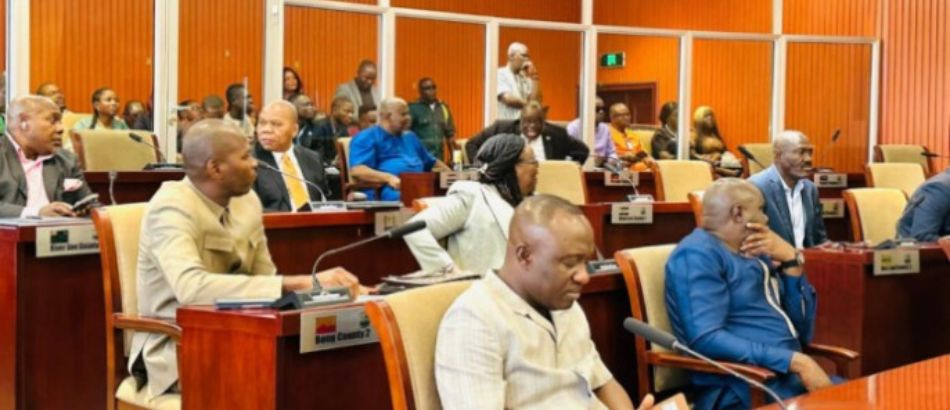
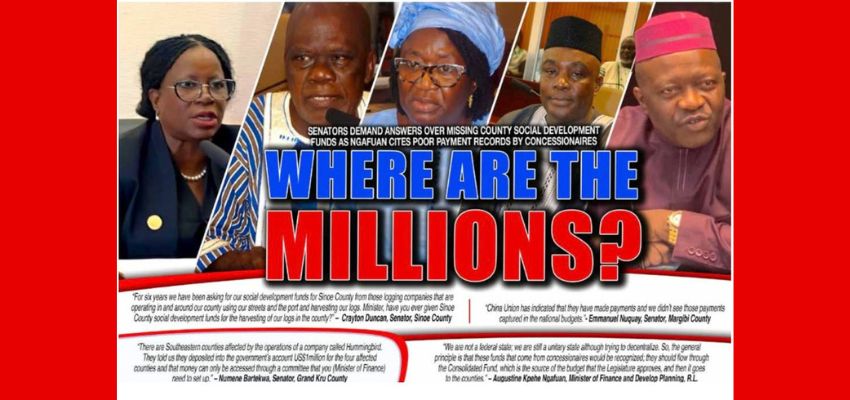
Monrovia – A growing controversy over millions of dollars reportedly paid by concession companies for county development projects took center stage at the Liberian Senate on Thursday, as lawmakers demanded answers from Finance and Development Planning Minister Augustine Kpehe Ngafuan regarding funds they say have failed to reach beneficiary counties.

Senators from several concession-hosting counties accused successive governments of withholding Social Development Funds (SDF) paid by companies operating in their regions, depriving citizens of much-needed infrastructure and social services.

The concerns were raised during a Senate hearing attended by Minister Ngafuan, who acknowledged longstanding challenges in tracking and disbursing the funds but maintained that records of many past payments remain incomplete.

The lawmakers cited reports from major concessionaires—including Hummingbird Resources, China Union, Western Cluster, and ArcelorMittal—that they had deposited millions of dollars into government accounts for onward transfer to affected counties.

However, senators said those funds have either not been reflected in national budgets or have not been disbursed to local authorities.

Leading the charge was Sinoe County Senator Crayton Duncan, who questioned whether his county had ever received social development funds from logging companies operating within its borders.

“For six years we have been asking for our social development funds from those logging companies operating in and around Sinoe County, using our roads and port facilities while harvesting our logs,” Duncan said. “Minister, have you ever given Sinoe County social development funds from the harvesting of our logs?”

Margibi County Senator Emmanuel Nuquay raised similar concerns regarding payments reportedly made by China Union.

“China Union has indicated that they have made payments, and we didn’t see those payments captured in the national budgets,” Nuquay told the Finance Minister.

Grand Kru County Senator Numene Bartekwa pointed to a reported US$1 million payment by Hummingbird Resources intended for four southeastern counties.

“There are Southeastern counties affected by the operations of a company called Hummingbird,” Bartekwa said. “They told us they deposited US$1 million into the government’s account for the four affected counties, and that money can only be accessed through a committee that you need to set up.”

Other senators joined the discussion, including Nimba County Senator Nya Twayen, who questioned the status of payments allegedly made by Ivanhoe Atlantic and expressed concern over delays in transferring concession-related revenues to Nimba County.

Grand Cape Mount County Senator Dabah Varpilah also raised concerns on behalf of counties in the western region.

“The Western Region Legislative Caucus also has concerns about monies paid by Western Cluster to government that have not been transferred to the counties,” she said.

The lawmakers argued that the continued delay in releasing Social Development Funds has denied residents in concession-affected communities access to roads, schools, clinics, and other critical development projects envisioned under concession agreements.

Responding to the concerns, Minister Ngafuan admitted that previous administrations had often failed to remit county development funds in a timely manner but stressed that the current government is working to improve the process.

“We are not a federal state; we are still a unitary state although trying to decentralize,” Ngafuan explained. “The general principle is that these funds that come from concessionaires should flow through the Consolidated Fund, which is the source of the budget approved by the Legislature, and then be allocated to the counties.”

According to him, government intends to reduce delays between the receipt of concession payments and their eventual disbursement to counties.

“If a concessionaire makes a payment in January, I don’t want a situation where counties receive that money in December,” he said. “We are working on that.”

Ngafuan disclosed that the Ministry has been engaging local authorities and reviewing procedures to ensure that legitimate payments are promptly released.

However, he acknowledged significant challenges in verifying some of the claims being made by concessionaires and county officials.

“Sometimes concessionaires will say they have paid the money, and when we check, we don’t find it,” he said. “But where we establish that payments were made and there are administrative actions required, those actions will be expedited so that the counties receive their money.”

The Finance Minister further revealed that while current payment records are available, historical records covering previous years are often incomplete.

“Past records are scanty,” Ngafuan admitted, pledging to work with the Liberia Revenue Authority (LRA) and the Comptroller and Accountant General’s Office to determine whether companies such as Hummingbird and others had made payments that were never transferred to beneficiary counties.

He also emphasized that the Ministry of Finance does not have unilateral authority to spend county social development funds.

“Those funds belong to the counties,” he said. “I can assure you that where we find evidence that concessionaires have made payments intended for counties, those counties will receive those funds.”

Ngafuan concluded by promising reforms aimed at improving transparency, accountability, and the timely transfer of Social Development Funds, while lawmakers signaled that they would continue pressing for answers on what they believe could amount to millions of dollars owed to counties across Liberia.

For many senators, the central question remains unanswered: If concession companies paid the money, where are the millions?


Source credit: By Obediah Johnson/Front page Africa

Former Foreign Minister Kemayah Dismisses Claims Ex-President Weah Has Quit 2029 Race

Monrovia – Former Foreign Minister Dee-Maxwell Saah Kemayah has firmly rejected reports suggesting that former President George Manneh Weah has abandoned plans to contest Liberia’s 2029 presidential election, insisting that the former Liberian leader remains committed to seeking a return to power.

Kemayah’s comments come amid growing speculation that Weah may have yielded his presidential ambitions to Alternative National Congress political leader Alexander Cummings as opposition parties explore possible alliances ahead of the next election cycle.

Speaking on the matter, Kemayah described such claims as false, unrealistic, and politically motivated.

“For anyone to think that His Excellency President Dr. George Weah, the 25th President of Liberia and the incoming 27th President of Liberia, will surrender that desire to contest the presidency to anyone on planet earth—that is inconceivable; it is not practical,” Kemayah declared.

“That thought in itself is diabolical, and it is wickedness to the Liberian people.”

He further dismissed suggestions that Weah would step aside in favor of another political figure.

“It is something that is not conceivable, something that is not practical. This is something far-fetched. This is something that is not possible. This is something that will not become reality,” he added.

‘Weah shall Be a Candidate’

Kemayah revealed that he had spoken with Weah on the same day the speculation surfaced and said the former president remains confident that Liberians will reject misinformation.

“Just this afternoon when President Weah called me during our usual chat, we were talking and not knowing that some would call and raise this issue. He said the Liberian people will reject lies and embrace the truth,” Kemayah stated.

According to him, Weah referenced scripture from the Gospel of John, emphasizing the importance of truth in public discourse.

While expressing respect for Cummings, Kemayah insisted that Weah’s political future remains unchanged.

“Cummings is a friend. He is one of the stakeholders in Liberia. I respect him and will always respect him,” he said.

Despite that acknowledgment, Kemayah maintained that Weah remains focused on the 2029 race.

“His Excellency President Dr. George Manneh Weah shall be a candidate come 2029. Not only shall he be a candidate, but he will go on to win,” he declared.

Kemayah said Weah will continue efforts to unite opposition forces to prevent President Joseph Nyuma Boakai from securing a second term.

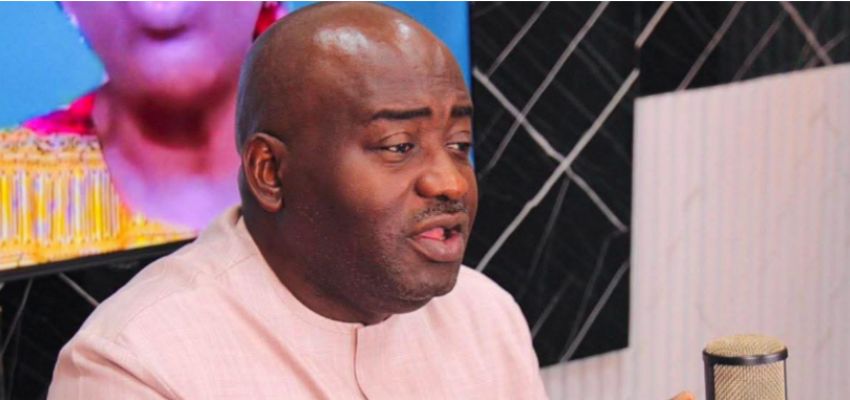
Former Foreign Minister Maxwell Kemayah dismissing rumors that former President George Weah has abandoned his political ambitions. Kemayah made the remarks during a live telephone interview on Freedom FM, insisting that Weah remains committed to his political future.

“He shall continue to rally them to ensure a united bloc within the opposition because our focus is to ensure that President Joseph Boakai becomes a one-term president,” Kemayah said.

Weah’s Changing Position on 2029

Kemayah’s remarks come against the backdrop of Weah’s evolving public statements about his political future.

Following his narrow defeat to President Boakai in the 2023 presidential election, Weah suggested that he would not seek another term in office. Speaking at his Forky Klon Jlaleh Family Fellowship Church in Paynesville, he cited his age and retirement considerations as factors in his decision.

At the time, Weah noted that he would be 63 years old by the 2029 election and questioned the practicality of serving only a few years before reaching retirement age.

However, the former president later reversed that position and publicly signaled his intention to return to the ballot.

At a CDC gathering in 2025, Weah accused the Unity Party administration of undermining democratic institutions and failing to address the country’s challenges.

“We have seen a systematic erosion of democracy, executive overreach, and disregard for our Constitution,” Weah said.

“They said we were the problem. But now the Liberian people can see who the real problem is. The Unity Party is the problem.”

He also assured supporters that the CDC was preparing for a political comeback.

“We will not give up on Liberia. We will not give up on CDC. We are the party of the slums and the cities. We are reorganizing, we are preparing, and we are coming back,” Weah declared.

Cummings Signals Interest in 2029

Meanwhile, Alexander Cummings has continued to increase his political visibility, fueling speculation that he, too, intends to contest the presidency in 2029.

Although the ANC has not issued a formal statement regarding reports of any arrangement involving Weah, party spokesperson Sensee Kiadii said the ANC remains open to political collaboration ahead of the next election.

Cummings, who has contested two previous presidential elections, recently engaged residents of Point Four and the Supermarket Community in Montserrado County District #16, where he spent much of his childhood.

Addressing supporters, he reflected on his upbringing and outlined his vision for national leadership.

Using a battery analogy to describe Liberia’s political challenges, Cummings argued that the country needs new leadership.

“If you have a battery radio and the battery runs down, putting the same battery back will not work. You need a new battery, and I am that new battery that the country needs,” he told residents.

The engagement forms part of Cummings’ ongoing grassroots outreach as he seeks to build support around a message of accountability, renewal, and economic transformation.

Opposition Landscape Taking Shape

With both Weah and Cummings signaling continued political ambitions, Liberia’s opposition landscape is gradually taking shape ahead of the 2029 presidential election.

While discussions about alliances and coalition arrangements are expected to continue, Kemayah’s latest comments leave little doubt about the CDC’s position.

According to the former foreign minister, any suggestion that Weah will step aside is misplaced.

For the CDC and its supporters, the message is clear: George Weah intends to be on the ballot in 2029.


Source credit:

By Gerald C. Koinyeneh, gerald.koinyeneh@frontpageafricaonline.com

IMF Completes Third ECF Review, Confirms Growth and Stability

The International Monetary Fund (IMF) has officially confirmed that Liberia’s economy expanded by 5.1 percent in 2025, subsequent to the successful completion of discussions under the Third Review of Liberia’s Extended Credit Facility (ECF) Arrangement.

An IMF staff team, led by Mr. Daehaeng Kim, visited Monrovia from January 7 to 20, 2026, and reached a staff-level agreement with the Government of Liberia concerning the third review of the nation’s economic reform program supported by the ECF.

The ECF arrangement, which received approval from the IMF Executive Board on September 25, 2024, provides total access of SDR 155 million (approximately US$210 million) over a 40-month duration.

According to the IMF, macroeconomic stability in Liberia continues to strengthen, supported by robust economic activity, sharply declining inflation, and a stable exchange rate. It reports that program performance since the second review has been relatively strong.

At the conclusion of the mission, Mr. Kim stated:

“Liberia’s economic and financial reforms continue to progress, supported by favorable macroeconomic outcomes. Real GDP growth is estimated at 5.1 percent in 2025, up from 4.0 percent in 2024, driven by strong mining activity and moderate expansion in the agriculture and services sectors. Inflation declined significantly, averaging 4.4 percent in the fourth quarter of 2025, compared to 12.5 percent in the first quarter, while the exchange rate remained broadly stable.”

The IMF mission further commented, “Fiscal performance has strengthened, with the primary fiscal surplus, excluding grants, improving from 1.3 percent of GDP in 2024 to 1.4 percent in 2025, exceeding the program target of 1.1 percent of GDP.”

The IMF emphasizes that steadfast reform implementation will remain essential to consolidating macroeconomic stability, reducing debt vulnerabilities, and strengthening the banking sector. Continued prudent fiscal policies, enhanced domestic revenue mobilization, improved public financial management, and stronger monetary policy effectiveness will be critical to sustaining stability and supporting development priorities.

During the mission, the IMF team engaged in consultations with President Joseph N. Boakai, members of the National Legislature, Minister of Finance and Development Planning Augustine K. Ngafuan, Central Bank of Liberia Executive Governor Henry F. Saamoi, senior government officials, and development partners.

Source credit: mfdp.gov.lr

Liberia’s Economy Grew 5.1% in 2025, Driven by Mining Boom

Liberia’s economy expanded by 5.1% in 2025, driven by a strong rebound in mining and continued gains in the services and agriculture. Mining sector growth increased to 17.0% from 2.1% in 2024, providing a significant boost to industrial output. The services sector grew by 4.4%, supported by trade, electricity supply, and transport activity, while agricultural growth eased to 2.6% as price effects faded and rubber output slowed.

Inflationary pressures remained contained, with headline inflation averaging 8.5% in 2025. Food inflation declined sharply from 9.7% year-on-year (y/y) in December 2024 to -1.7% by December 2025, while nonfood inflation moderated from 11.1% (y/y) to 6.6% over the same period.

The Central Bank of Liberia maintained its restrictive policy stance, cautiously easing its policy rate from 17% in January 2025 to 16.25% in December, a measured intervention that reflected the inflation dynamics.

Liberia’s fiscal performance improved considerably in 2025.The overall fiscal deficit narrowed to 1.1% of GDP in 2025 from 2.0% the previous year, driven by growth in domestic revenue and compressed spending. The primary balance swung to a surplus of 0.2% of GDP, compared to a deficit of 1.0% in 2024. Public debt declined from 57.2% of GDP in 2024 to 54.6% in 2025.

On the external side, the current account deficit declined from 8.1% of GDP in 2024 to 6.5% in 2025. Export performance was robust, led by gold and iron ore, however, the gains in exports were offset by rising imports and sizable outflows from services and income. Remittances provided some cushion, helping to contain the overall deficit. Liberia’s external buffers remain limited, with foreign reserves standing at $576 million, an equivalent of approximately 2.0 months of import cover at end-2025.


Source credit: World Bank Country Page

World Bank Releases 2025 Liberia Economic Update: Focus on Private Sector Jobs

The World Bank today released the Sixth Edition of its annual Liberia Economic Update, titled “From Stabilization to Inclusion – Pathways to Resilient Growth and Productive Jobs.” The report, focusing on Liberia’s recent economic developments, analyzes the status of the private sector and how it can be strengthened to deliver productive jobs.

The report highlights the importance of unlocking employment potential which requires enabling firm growth, expanding production capacity, and addressing spatial and sectoral concentration. As currently structured, Liberia’s private sector is unable to generate quality jobs on a large scale, amid a prevalence of informal, micro-sized firms with limited employment capacity.

Achieving sustained and inclusive growth requires confronting Liberia’s employment challenges and maintaining macroeconomic stability,” said Georgia Wallen, World Bank Country Manager for Liberia. “Structural weaknesses in the labor market and the private sector continue to constrain the country’s growth potential. Tackling these barriers is essential not only for reducing poverty, but also for sustaining macroeconomic gains through a stronger domestic tax base, greater resilience to external shocks, and enhanced social cohesion.”

The update emphasizes that transformation of Liberia’s employment landscape hinges on a four-pronged strategy: stimulating labor demand through investment in agro-processing and light manufacturing; enabling firms growth through regulatory, financial, and technological support modernizing the business environment through high-level coordination, enabling legal environment, and public private Partnerships, and expanding labor participation through skills, youth, and gender-focused interventions.

Transformation of the country’s employment status should be complemented by long-term investments in education and human capital, improved market access for local firms, and targeted incentives for firms that offer wage employment,” said Gweh Gaye Tarwo, Liberia Country Economist and lead author of the report. “Aligning industrial and labor policies with spatial development priorities and value-chain potential will also be essential to drive inclusive job creation and reduce regional disparities in employment opportunities.”


Source credit: World Bank Country Page

Pres. Boakai Reaffirms Administration’s Commitment to Fiscal Discipline

President Joseph Nyuma Boakai said in order to execute the National Budget successfully, fiscal discipline should be the hallmark in the process.

In a communication submitting the draft national budget for fiscal year 2024, President Boakai said the successful execution of this Budget in a credible fashion will require that the government takes certain deliberate actions collectively.

“Firstly, fiscal discipline must be our guiding principle for budget execution. The Amended and Restated PFM Act, the PFM Regulations, and the Fiscal Rules must be adhered to by all at all times. Secondly, heads of spending entities must exercise their fiduciary responsibility to ensure the highest degree of fiscal probity and accountability as the Budget Holders,” the President said.

President Boakai had campaigned on the promise to take drastic measures aimed at curbing corruption and raising the living standard of his fellow Liberians. Although Liberia’s Public Financial Management Law calls for spending entities to make periodic reports to facilitate routine audits, this clause has been ignored over the years with the Legislature consistently approving national budgets without obtaining periodic reports from spending entities.

The president said it was now time to stop this practice and “restore this missing link.”

“We must be reminded about the requirements of the PFM Law that spending entities make periodic reports to facilitate routine audits. Adherence to these requirements has been the missing link in our budget execution and must be restored. I urge heads of spending entities to lend their fullest cooperation as we endeavor to depart from business as usual to pursue a path of transparency and accountability in public financial management.”

The passage of the national budget has experienced an unprecedented delay. This is due to the House of Representatives’ decision to send back the draft budget for fiscal year 2024 presented to the Legislature by Boakai’s predecessor George Weah before his exit from office.

In his communication, President Boakai emphasized that his government has missed nearly the entire first quarter of the fiscal year of full budget execution. He said this delay has caused disruption in the implementation of programs and projects earmarked by his administration.

“The delayed commencement of fully executing the budget and the approaching rainy season have traditionally adversely affected the timing and implementation of programs and projects. It is against this background that I implore your indulgence to expeditiously enact the draft FY2024 Budget into law for its full execution,” he urged.

Budget Summary

The proposed resource envelope for the FY2024 budget as submitted by the President is projected at US$692.4 million, of which tax revenue accounts for US$540.2 million or 78 percent and Non-tax Revenue of US$109.8 million or 16 percent. Externally sourced revenue is projected at US$42.4 million or 6 percent of the revenue estimate Compared to the FY2023 budget outturn of US$793.3 million.

In his submission, the President said the FY2024 budget represents a decrease of 12.7 percent, which he attributed to a decrease of US$144.6 million in external financing. The President noted that in order to manage the debt portfolio which crowds out spending on critical priorities, his Government has decided to exercise fiscal restraint and discipline when it comes to acquiring new debts. This decrease, he revealed, will be offset by increases in Tax Revenue of US$16.7 million or 3% and Non-Tax Revenue of US$27.0 million or 33%.

Medium-Term Horizon

The President announced that the medium-term projections for domestic revenue for the outer years 2025 and 2026 are set at US$675.5 million and US$712.1 million, respectively. Of these amounts, he said 2025 tax revenues are estimated at US$560.3 million (83 percent) and nontax US$115.2 million (17 percent). In 2026, tax revenue will rise to US$591.2 (83 percent) and nontax US$121.0 million (17 percent), he said.

Proposed Expenditure Priorities

The proposed expenditure for FY2024 is shared between recurrent expenditure of $640.5 million or 93 percent and public sector investment projects (PSIP) is US$51.9 million or 7 percent. Among the key recurrent expenditures, the President outlined, are debt services to commercial banks arising from construction projects and to multilateral institutions in order to unlock support to medium-term development priorities. Other recurrent expenditures are compensation of employees, operational goods and services for government entities and subsidies, grants and transfers to governmental and non-governmental institutions in the health and education and social service sectors.

Recurrent Expenditure

The government allocated the proposed recurrent expenditure of US$640.5 million towards major expenditure categories including debt service (domestic and foreign) US$129 million, compensation of employees US$297 million, use of goods and services US$90.2 million (including US$4.7 million for drugs and medical consumables), acquisition of non-financial assets US$3 million, social benefits (pensions, retirement benefits, etc.) US$17.9 million, subsidies US$1.7 million and grants US$101.7 million.

Public Sector Investment Projects

The President acknowledged that the national budget is the framework for planning and executing short, medium and long-term public sector investments that will reduce the infrastructure and other capacity gaps that constrains growth and development. However, he said given the limited time to design and formulate projects through the regular sector working group for inclusion in the budget, ongoing public sector investment projects that are aligned with the ARREST Agenda have been prioritized such that allocations for those projects are ring-fenced to ensure their completion.

The government’s proposed allocation for Public Sector Investment Projects is US$51.9 million, and of this amount, some “critical programs” that have been prioritized within the PSIP envelope include the allocation of US$26.3 million to Road Fund projects; US$13.9 million to 100-day Deliverables; US$3.6 million to District Development Projects; US$1.8 million to Youth ICT Capacity Building; and US$1.5 million for Asset Recovery Task Force.

The House then forwarded the President’s communication to its Ways, Means, Finance Committee to report within two weeks.

World Bank Announces New Country Director for Ghana, Liberia, and Sierra Leone

The World Bank has appointed Robert Taliercio O’Brien as Country Director for Ghana, Liberia, and Sierra Leone in the Western and Central Africa Region. His appointment takes effect from January 2, 2024, and he will be based in the World Bank’s Accra Office.

Taliercio, an American national, joined the World Bank in 2000 as a Young Professional in the Africa region and has served as Practice Manager, Lead Economist, and Country Economist in multiple regions, including East Asia and the Pacific, Europe and Central Asia, and Africa. His most recent assignment has been as Regional Director in the Latin America and Caribbean Region for the Equitable Growth, Finance, and Institutions (EFI) Department.

Prior to joining the World Bank, Taliercio was a Lecturer in Public Finance at the Harvard Institute for International Development and a Manager for HIID’s Program on Investment Appraisal and Management. He also served as a visiting professor at the Bolivian Catholic University. He has written on public finance policy and administration in academic journals, books, and development publications. He has received service awards from the Ministers of Finance of the Republic of Korea and the Kingdom of Cambodia.

In his new position, Taliercio’s top three priorities will be to (i) lead the Bank’s strategic dialogue with these countries and support the implementation of the Africa Region’s priorities, (ii) deepen the policy dialogue and partnership with governments, and key stakeholders, and (iii) oversee the delivery and implementation of the lending and non-lending portfolio.

Taliercio holds a Ph.D. and a Masters in Public Policy from Harvard University, a Master of Arts in Latin American Studies from Stanford University, and a Bachelor of Arts in Public and International Affairs from Princeton University. He has written on public finance policy and administration in academic journals, books, and development publications.

We need strong leadership and political will to get ECOWAS MPs elected

One major concern for political watchers with regards to the Economic Community of West African States (ECOWAS) Parliament is whether we will ever get to a point of electing its lawmakers.

This, a member of the 5th Parliament, Hon Emmanuel Kwasi Bedzrah said requires strong leadership and political will to achieve.

According to him if there is a strong leadership and political will the election of ECOWAS MPs will be achieved and blames the current leadership for not doing much to actualize this important feat.

He asserts that the current Speaker Rt. Hon Sidie Mohammed Tunis came with the drive to have direct elections to the Community Parliament actualized; unfortunately that drive fizzled down.

“I do not know what happened and why he could not push for this agenda or whether the Authority of Heads of States and Government decided not to accept his proposal or is from him personally or from us as MPs from the ECOWAS Parliament. It has not happened. Whoever is taking over in the 6th legislature that is the next Parliament, should be able to drive this agenda home and should be one of the priority areas for that person to leave a legacy that during my tenure in office I was able to get members elected into that Parliament.”

Liberia: Boakai Sworn in as Liberia’s 26th President

Joseph Boakai, former Vice President and a veteran politician with 40 years of experience, has been sworn in as Liberia’s new president after winning the election against outgoing President George Weah.

During his campaign, Boakai emphasized his commitment to addressing key challenges faced by the country, including corruption, poverty, and infrastructural development.

The inauguration ceremony, held on Capitol Hill in Monrovia, was attended by various foreign leaders and diplomatic delegations, highlighting the significance of this transition of power. Boakai’s election victory signifies hope for the Liberian people, who have long-awaited efforts to combat corruption and improve their living conditions.

Liberia, with a population of 5 million, has experienced its fair share of challenges, including corruption, poverty, and a weak justice system, due to years of civil war. Many citizens hope that Boakai’s presidency will bring positive change, such as job creation, economic improvement, institution strengthening, and the fight against corruption.

Furthermore, there are expectations for him to prioritize the provision of stable electricity and water, as well as enhance the road infrastructure to attract investments. The outgoing government’s failure to establish a war and economic crimes court and address impunity has left unresolved issues from the civil wars.

Additionally, concerns have been raised regarding the mysterious deaths of four government auditors during this period. Despite these challenges, Boakai’s reputation for leading a life free from corruption has raised hopes among Liberians.

They anticipate that his experience and dedication will pave the way for a brighter future, marked by improved living conditions and a more prosperous nation.